Research
Heatwaves and Health at Birth
Alejandra Paz Rivera-Vicencio
Working paper · Draft available soon
Heatwaves are becoming more frequent in Spain, and pregnant women are among the groups that health
authorities consider most at risk. This paper asks how heat during pregnancy affects health at birth,
and when in pregnancy it matters most. I study all 4.73 million singleton births in Spain between 2007
and 2024, link each birth to the heatwaves recorded in the mother's municipality of residence, and
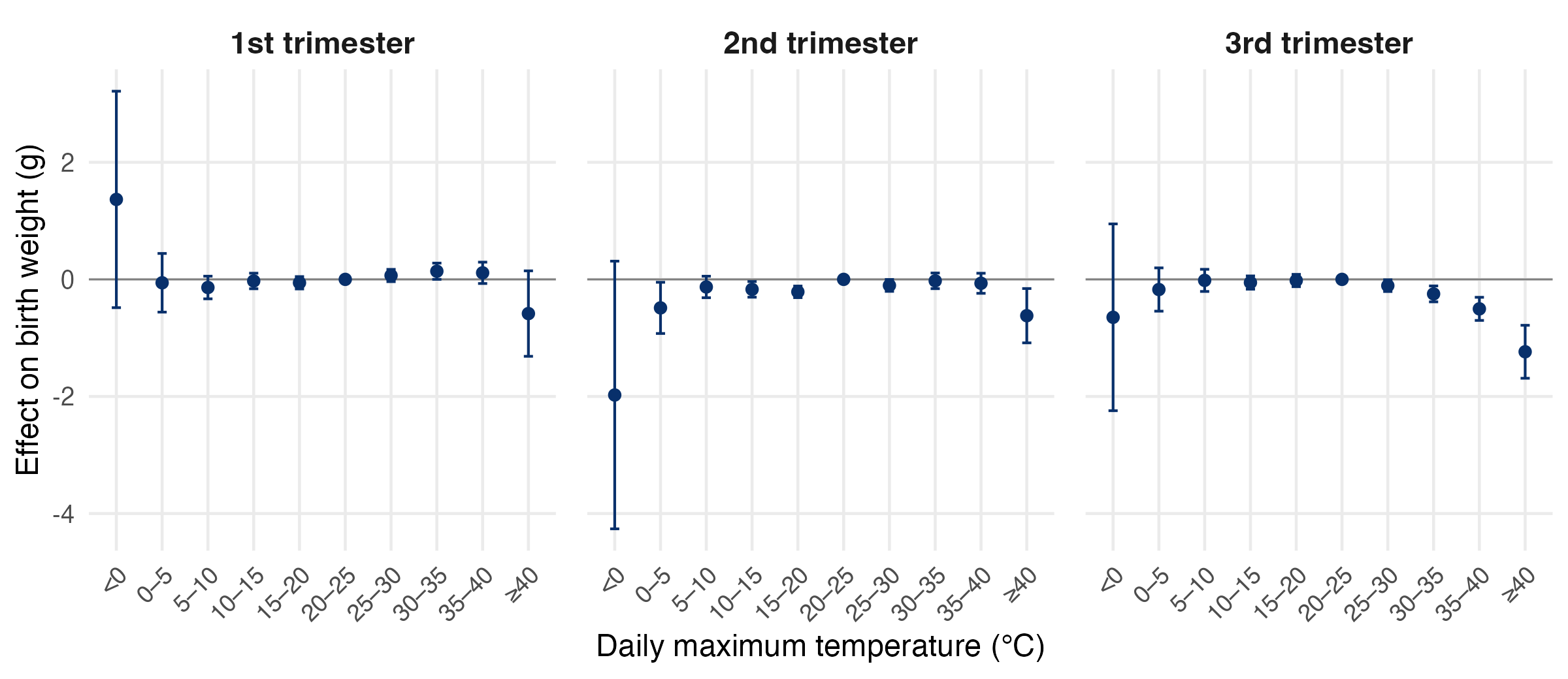
measure exposure in windows of fixed length counted from the month of conception. Heat in the third
trimester, when the foetus gains most of its weight, lowers birth weight by about a third of a gram per
heatwave day, and by more on the hottest days, while heat earlier in pregnancy has no detectable effect.
The effect works through fetal growth rather than through shorter pregnancies, is similar for mothers
of different backgrounds, and has not declined over time. I also show that counting heat from
conception to birth, a common choice, can make heat look protective, because longer pregnancies include
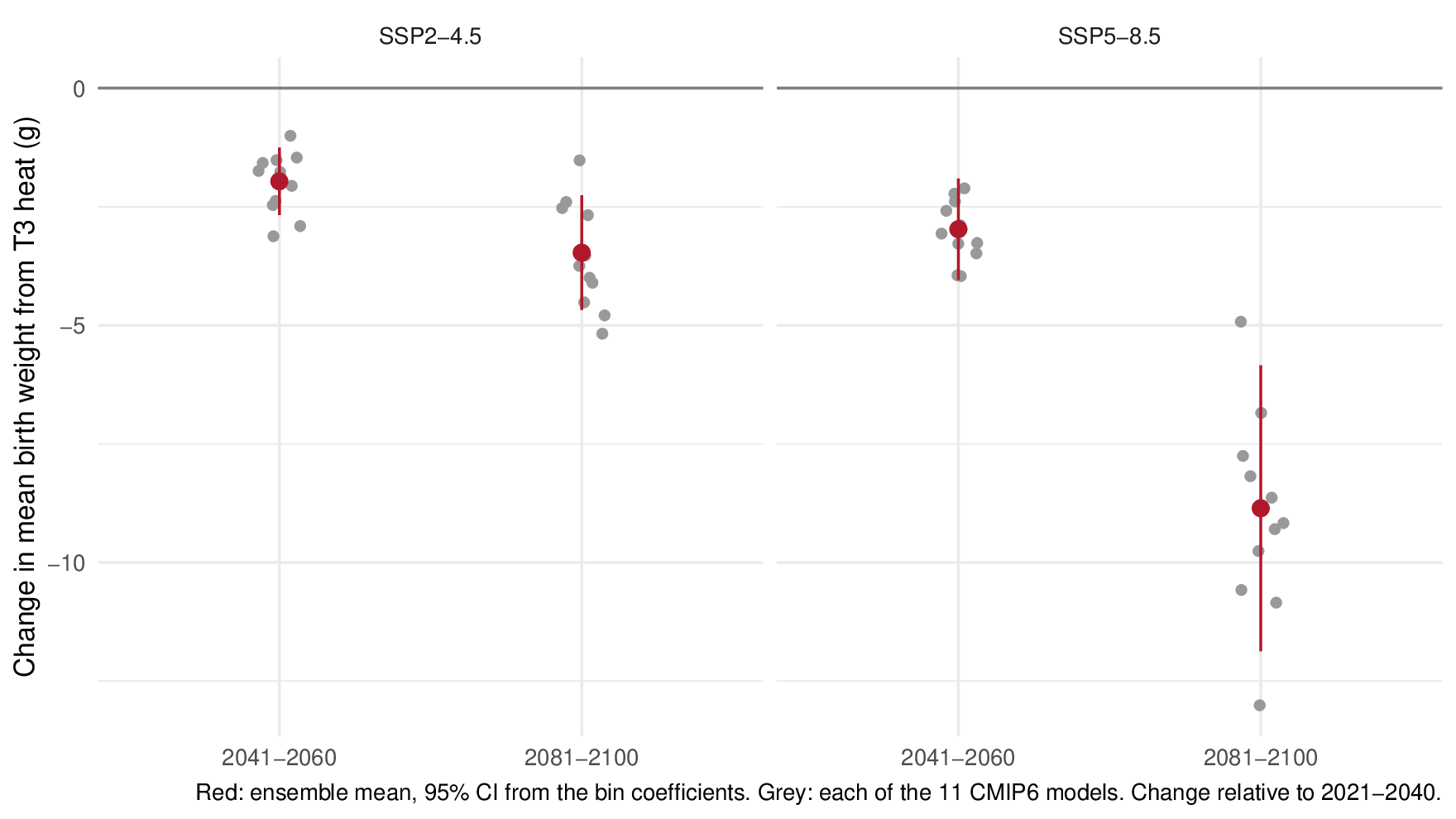
more summer days. With the warming projected for Spain, these small daily effects add up, which suggests
a simple form of protection: guidance for women in the last months of pregnancy during heatwaves.
Presentations: Simposio de la Asociación Española de Economía (SAEe), Universidad de Las Palmas de Gran Canaria, 16–18 December 2026 upcoming
Does One Advertisement Change What Adolescents Choose to Eat? Evidence from a Randomised Experiment in Catalan Schools
with Judit Vall-Castelló and Guillem Riambau
Working paper · Draft available soon
Childhood obesity in Spain is among the highest in Europe, even though the country is known for the
Mediterranean diet, and obesity in adolescence tends to persist into adult life. One policy response
proposed in Spain is to restrict the advertising of foods high in fat, salt and sugar (HFSS) aimed at
children. We study whether a single 30-second television advertisement for an HFSS food changes the snack
choices of adolescents. We ran a randomised experiment in five schools in the province of Barcelona, where
288 children aged 11 to 17 watched a children's news programme with one commercial break. In each school,
one session saw an advertisement for a chocolate milk drink with biscuits and the other session saw an
advertisement for a theme park. Afterwards, every child chose a snack for the same afternoon and for the
following week. Because the advertised product was one of the options, we can measure two effects: on the
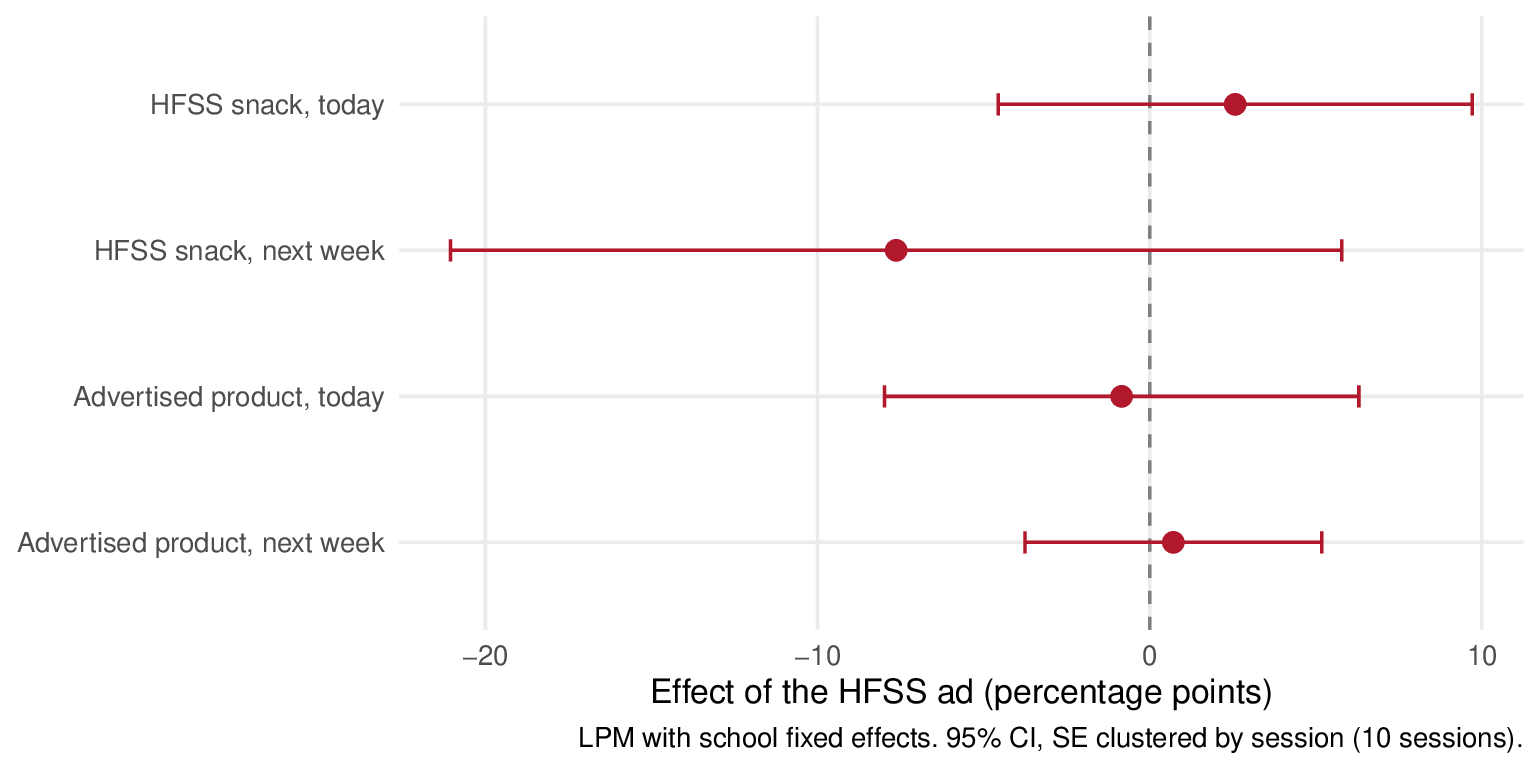
choice of the advertised product and on the choice of any HFSS snack. On average, the advertisement does
not change choices. The effect on choosing the advertised product is −0.8 percentage points, and the
effect on choosing an HFSS snack is 2.6 points, with exact randomisation p-values of 0.94 and 0.62.
The design rules out effects larger than 6.6 and 8.4 points, but not the smaller effects reported in
earlier studies. Exploratory analyses suggest larger responses among older children, but this pattern is
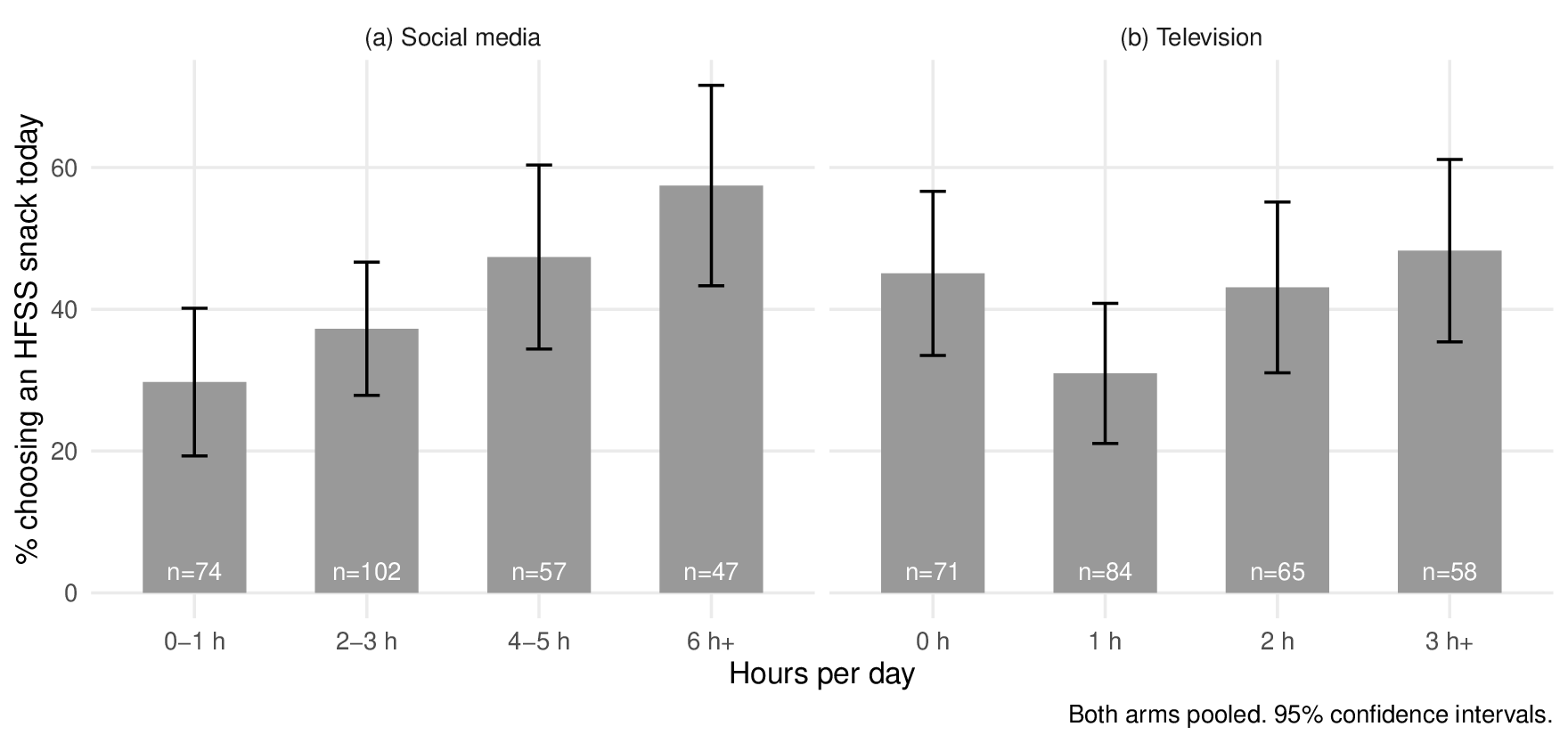
closely tied to differences between schools. Hours of social media are associated with choosing HFSS snacks.
Presentations: 12th PhD Student Workshop on Industrial and Public Economics (WIPE), 2024 · METADIS Joint Symposium, 2023 · EURODIET Early Career Seminars, 2022
The 2024 Valencia Floods and Health at Birth
Alejandra Paz Rivera-Vicencio
Work in progress
On 29–30 October 2024, an extreme rainfall episode (DANA) caused catastrophic flooding in the province
of Valencia. This project studies how exposure to the floods during pregnancy affected health at birth.
Using administrative birth records and the official list of severely affected municipalities, I compare
births in affected and unaffected areas before and after the floods, by the trimester of pregnancy in
which the disaster occurred.
Very preliminary: early estimates using public birth records suggest that births exposed
to the floods late in pregnancy had lower birth weight. These results cover only the first two months
after the floods and only the larger affected municipalities (smaller towns, which suffered much of the
damage, are anonymised in the public data), and they are sensitive to the choice of method. They should
not be cited.